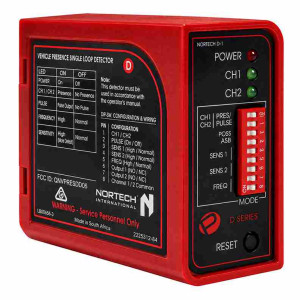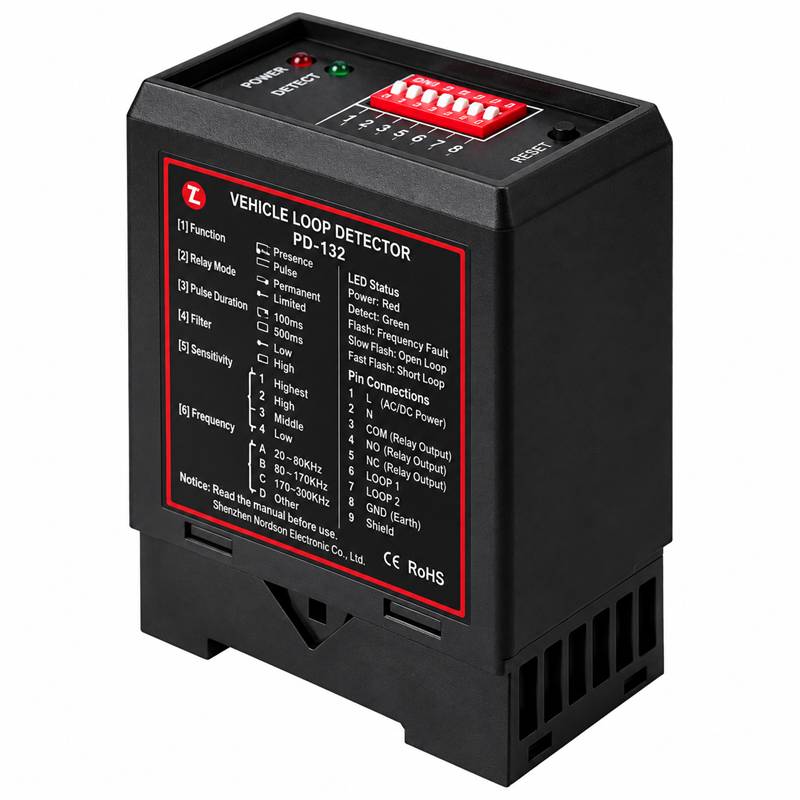
PD-132 24V Vehicle Loop Detector
Price 120 AEDIn Stock
PD-132 24V Single-Channel Vehicle Loop Detector UAE
PD-132 24V is a professional single-channel inductive vehicle loop detector designed for automatic parking barriers, sliding gates, vehicle access control and traffic-management applications. The detector identifies the presence of a vehicle through an inductive loop cable installed beneath the road surface.
This 24V PD-132 loop detector provides a fast 10 ms response time, four adjustable sensitivity levels and a wide operating frequency range of 20 kHz to 170 kHz. It can be used for automatic barrier opening, vehicle-presence detection and safety-loop applications depending on the connected gate or barrier controller.
PD-132 24V Key Features
- Model: PD-132 24V
- Single-channel inductive vehicle detector
- Designed for one vehicle detection loop
- Low-voltage 24V version
- Fast detection response: 10 ms
- Frequency range: 20 kHz to 170 kHz
- 4 adjustable sensitivity levels
- Loop inductance range: 50 μH to 1000 μH
- Recommended loop inductance: 100 μH to 300 μH
- Selectable permanent or limited vehicle presence
- Maximum loop connection cable: 20 metres
- Compact plug-in detector housing
- Suitable for parking barriers and automatic gates
- Suitable for vehicle presence and safety detection
PD-132 24V Technical Specifications
| Model | PD-132 24V |
| Product Type | Inductive Vehicle Loop Detector |
| Detection Channels | Single Channel |
| Supply Voltage | 24V AC* |
| Response Time | Approx. 10 ms |
| Frequency Range | 20 kHz – 170 kHz |
| Sensitivity | 4 Adjustable Levels |
| Loop Inductance Range | 50 μH – 1000 μH |
| Recommended Loop Inductance | 100 μH – 300 μH |
| Presence Holding | Unlimited / Limited to 10 Minutes |
| Maximum Lead Cable Length | 20 m |
| Lead Cable | Twisted minimum 20 times per metre |
| Operating Temperature | -20°C to +65°C |
| Storage Temperature | -40°C to +85°C |
| Housing Dimensions | 78 × 40 × 108 mm |
| Applications | Parking Barriers, Automatic Gates & Vehicle Access Control |
*Confirm the voltage printed on the detector label before connection. PD-132 units are manufactured in different supply-voltage versions.
How the PD-132 Vehicle Loop Detector Works
The PD-132 operates with an inductive loop cable installed beneath the roadway. The loop creates an electromagnetic field. When a vehicle passes over or stops above the loop, the metal mass of the vehicle changes the loop inductance.
The detector recognizes this change and activates its output relay, allowing the connected gate, parking barrier or access-control system to respond according to its programming.
Fast 10 ms Vehicle Detection
With an approximate 10 millisecond response time, the PD-132 can quickly detect vehicles entering the loop area. Fast detection is useful for automatic parking barriers and vehicle access systems where the controller needs an immediate detection signal.
4 Adjustable Sensitivity Levels
The PD-132 provides four adjustable sensitivity levels. This allows the installer to tune the detector according to the loop size, installation conditions and type of vehicle being detected.
If the sensitivity is too high, unwanted or unstable detection may occur. If it is too low, smaller vehicles may not be detected reliably. Correct loop construction and sensitivity adjustment are therefore important.
Loop Inductance & Cable Requirements
The PD-132 supports a total loop inductance of approximately 50 μH to 1000 μH. For normal installations, the recommended loop inductance is approximately 100 μH to 300 μH.
The connection cable between the road loop and detector should be kept as short as practical, with a maximum recommended length of approximately 20 metres. The lead cable should be twisted at least 20 times per metre to reduce electrical interference.
Vehicle Presence & Safety Loop Operation
The PD-132 can be used as a vehicle presence detector. When a vehicle remains above the inductive loop, the detector can maintain its output according to the selected presence setting.
This makes it suitable for parking barrier safety applications where the barrier should not close while a vehicle remains within the protected detection area.
Automatic Parking Barrier Opening
The detector can also be connected to a compatible barrier controller's OPEN input. When a vehicle reaches the loop, the PD-132 relay sends an opening command to the barrier controller.
This configuration is commonly used for automatic exit lanes where vehicles should open the barrier without requiring a remote control, access card or push button.
PD-132 24V Applications
- Automatic parking barriers
- Boom gate barriers
- Automatic sliding gates
- Automatic swing gates
- Vehicle access-control systems
- Automatic exit lanes
- Barrier safety loops
- Vehicle presence detection
- Commercial parking facilities
- Residential compounds
- Warehouses and factories
- Security checkpoints
PD-132 24V vs 230V
| Specification | PD-132 24V | PD-132 230V |
|---|---|---|
| Supply | 24V | 230V AC |
| Channels | 1 | 1 |
| Response | Approx. 10 ms | Approx. 10 ms |
| Sensitivity | 4 Levels | 4 Levels |
Important: The different voltage versions are not interchangeable. Always confirm the voltage printed on the detector before wiring power to the unit.
PD-132 24V Loop Detector UAE
We supply PD-132 24V vehicle loop detectors throughout the UAE for parking barriers, automatic gates and vehicle access-control systems.
Professional loop cutting, loop cable installation, wiring, programming and technical support are available across Dubai, Sharjah, Abu Dhabi, Ajman, Ras Al Khaimah, Fujairah, Umm Al Quwain and Al Ain.
Before Ordering: Confirm that your installation requires the 24V PD-132 version. Separate PD-132 12V and 230V versions are available and must not be connected to the wrong supply voltage.